Inside the U.S. Capitol, statues memorialize distinguished Americans, including famed social commentator and actor Will Rogers, who once quipped about Congress, “Every time they make a joke, it’s a law, and every time they make a law, it’s a joke.”
Humor like that still rings true to the nearly 9 in 10 Americans who say they’re unhappy with Congress.
“It’s a great American pastime to hate Congress,” said Carl Hulse, chief Washington correspondent for The New York Times. “But I do think there’s a lot of frustration with Congress.”
Hulse has covered Capitol Hill since the Reagan administration. Asked if he sees a broken institution today, he replied, “Oh yes, totally. I unfortunately have said to people, ‘I’ve spent my career covering the decline of Congress.’ And yeah, they need to get it together. But there’s just very, very little cooperation between the parties, and you can’t make things happen that way.
“I do think a lot of them want to do the right thing, and they just can’t quite get themselves there to do it,” he added.
The fact is, under the Constitution, Congress really does have power. “Article I is a real thing,” said Hulse. “I think what’s happened with the Republicans in this Congress, and ceding power to the administration, has been a real mistake on a lot of fronts – tariffs, war powers, the things that are actually enumerated in the Constitution. They’re giving away the store. And once you give away some power, you never get it back.
“The Republicans might be looking at this and going, ‘Well, you know, this is President Trump, our guy. We needed to do that.’ Trust me: the next Democratic president isn’t going to turn around and say, ‘You know, that was a big mistake letting Congress get so weak. We need to empower them again.’ No, it’s not gonna happen. It goes for good.”
Pointing fingers
These days, Republicans control the Senate and the House, and legislation often faces gridlock. So far, the 119th Congress has passed fewer bills than many of its predecessors.
Some bills, though, have had real impact. There was the GOP mega-bill that will cut taxes by $4.5 trillion over the next decade, and a recently-passed bipartisan housing bill.
This Congress also will be remembered for the partial government shutdown over funds for homeland security.
Still, critics left and right want more to be done, be it raising, or cutting, federal spending. And whatever its problems, Congress has been routinely bypassed altogether by President Trump, whether on trade or the war with Iran. He also pressures them to do his bidding, like urging an overhaul of federal voting rules this past week.
This is an especially uncertain time in the Senate. Former majority leader Mitch McConnell has been hospitalized for weeks, and South Carolina Republican Lindsey Graham died suddenly this month.
For Hulse, these disruptions underscore how Congress is grappling with age, and an increasingly grim political climate – worse, he says, than when he first came to Capitol Hill four decades ago: “1985, Congress was different,” he said. “Lot of World War II vets who had already experienced a lot of life. So, this was not, you know, a big, difficult thing for them. They were trying to do the right thing.
“And now it’s both parties, much more aligned with the President. Hard to get things done. Margins are tight. The districts are really gerrymandered. There’s a lot wrong with Congress.”
Who is to blame? Both parties point the finger at the other for the mess. Rep. Peter Welch (D-Vt.) said, “Well, the Republicans don’t control the House; the place is chaos.”
Meanwhile, Sen. Katie Britt (R-Ala.) said, “Unfortunately, Democrats have chosen to play politics and put that over people time and time again under this administration.” Sen. Chris Coons (D-Del.) told us, “You’ve got the biggest voice in the room, Trump, fighting against his own Congress.”
“People should be mad”
Sarah Binder, senior fellow at the Brookings Institution, says that the legislative branch is “struggling,” while Philip Wallach, senior fellow at the American Enterprise Institute, describes Congress as “marginalized” – the result, in part, of an empowered president.
Asked whether she believes Congress is broken or diminished, Binder replied, “Well, both, for sure. Certainly diminished in the sense that it has enormous authority under the Constitution: Power of the purse, power to declare war. And yet, oftentimes, not just under Trump, this current president, but reaching back decades, Congress cedes that authority to the president. All the authority on the table, but struggling to try to use it, or even to try to get it back.
“So, the muscle memory for how to make deals, how to legislate, how to solve problems? The muscles, they’re there, but they’ve really atrophied,” Binder said.
“For me, what’s changed is how the members themselves see their jobs,” said Wallach. “I think what we’ve lost is the sense that, I’m sent here to solve the problems of the American people. I have to find a way to do that. That means building coalitions. That means compromise. Compromise has too much become a dirty word in American politics today. There’s a sense that if you’re willing to compromise, you’re not really holding true to your values.
“Today, people see their job as supporting the White House when it’s their ally there – or fighting against them in various ways when it’s the other party that has the presidency. And since Congress has for decades ceded so much authority to the executive branch, there’s a sense among the members on Capitol Hill, that’s where the real action is – in the executive branch, [and] in the judiciary.”
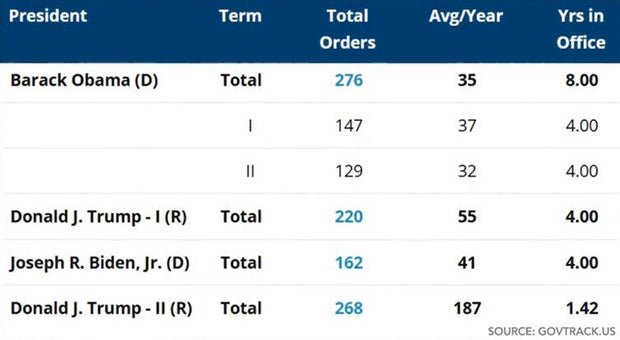
In his current term, President Trump has issued a flurry of executive orders — over 260 so far. The two presidents before him issued many of their own, leaving many Americans to wonder, What is Congress doing?
CBS News 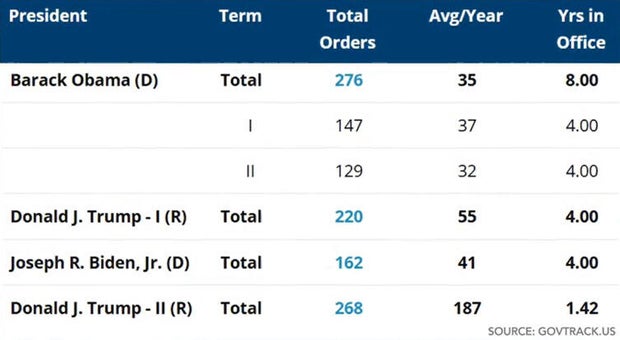
Is the public being too hard on Congress? “I think the truth is, Congress doesn’t need to be a very popular organization, even if it’s working well,” said Wallach. “The old line about lawmaking and sausage-making is there for a reason. There’s something unseemly about the way legislative politics has to operate that makes it hard to be really popular as a Congress.”
“I think the public should be hard on Congress,” Binder said. “There’s $30 trillion in public debt; Social Security seemingly on the brink if they don’t act soon – the whole host of issues and problems that we see around us. The cost of housing? People should be mad.
“At the same time, the public often does have quite unreasonable expectations of what’s possible. You need big, broad bipartisan majorities to get stuff done,” she said. “And in a polarized America, with factions in each party, that’s really hard.”
For Binder and Wallach, today’s Congress might be troubled, but it is, as ever, a reflection of its times – and of the people it represents.
Looking ahead, are they hopeful about Congress?
“I am an eternal optimist, but I’m not that hopeful about Congress,” said Binder. “I think the problems and the roots of the problems we’ve been talking about, they’re going to be with us for a long time. And whenever Congress has difficulties trying to tackle problems, they kick ’em to the future. And that just means the challenges are going to get harder.”
“I will say, taking the very long view about Congress makes me a little bit more hopeful,” Wallach said. “Congress has looked a lot of different ways over our two centuries. Members have found ways to reform the institution to make it act completely differently. And so, I think at some point, we’re gonna turn a corner. Congress has the power to regenerate itself, to put itself back at the center of the action. And I expect someday it may do that.”
For more info:
Story produced by Robbyn McFadden and Reid Orvedahl. Editor: Jason Schmidt.