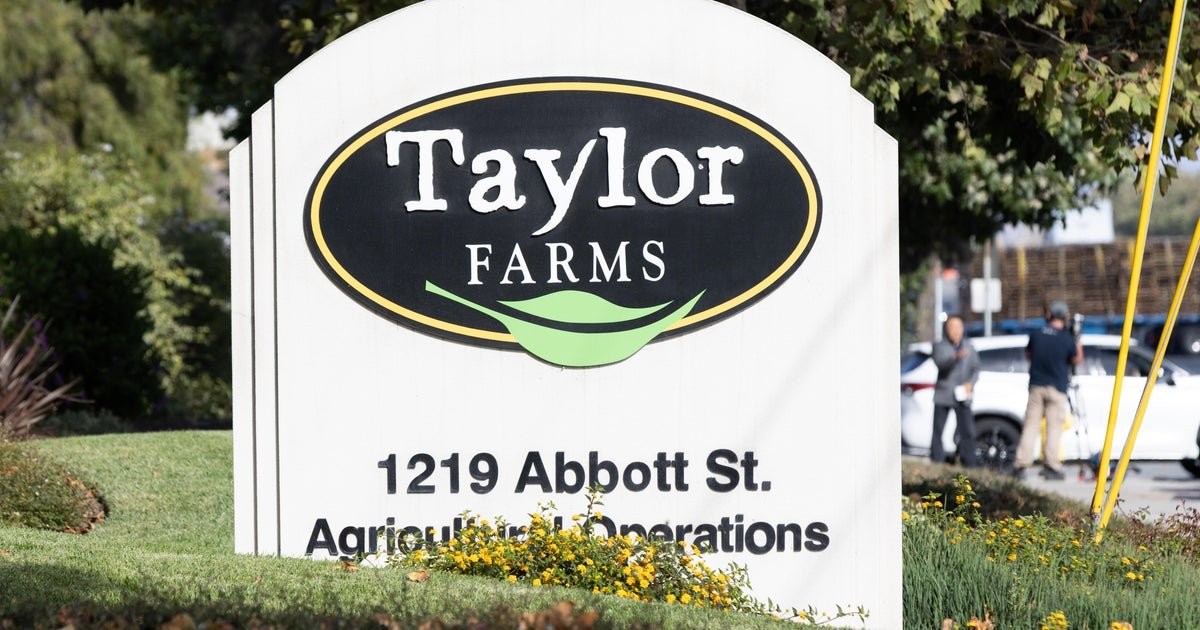
Produce giant Taylor Farms is under renewed scrutiny after it voluntarily recalled iceberg lettuce linked to the nation’s unusually large cyclosporiasis outbreak.
Food safety experts say that while recalls are inevitable for a produce supplier the size of Taylor Farms, the current outbreak is unusual because of its scale and the number of people sickened.
More than 5,000 cases of cyclosporiasis have been reported, far exceeding the typical annual level of roughly 200 to 1,000 cases. Because cyclospora infections can cause severe diarrhea lasting days or even weeks, some consumers are avoiding leafy greens and other fresh produce commonly associated with the parasite while investigators search for the source.
“Nothing about this outbreak is typical,” Jennifer McEntire, founder of food safety consulting firm Food Safety Strategy, told CBS News. “When you see something of this magnitude, it’s surprising, even to those of us who are accustomed to working with outbreaks. This is not normal, and it’s not acceptable.”
Taylor Farms did not immediately respond to CBS News’ request for comment.
How big is Taylor Farms?
Taylor Farms, founded by CEO Bruce Taylor in 1995 in Salinas Valley, California, manages a network of dozens of production facilities in the U.S., Canada, Mexico, and Western Europe. It grows one-quarter of its own produce and partners with family-owned farms to supply the rest, the company said in its 2025 impact report.
The company, which employs 25,000 people, booked $6 billion in revenue in 2022, according to the most recent data available, ranking it among the largest produce suppliers in the U.S.
Its sheer size positions it as a key supplier of lettuce and other produce to the nation’s biggest retailers, including Walmart, Costco, Target and Whole Foods, and restaurant chains Taco Bell and McDonald’s. The company also owns the organic brand Earthbound Farms, and produces 40% of the salad kits sold in the U.S.
Consumers may mistake Taylor Farms for a small single-farm operation based on its name alone, McEntire said. “But it’s not. It’s an enormous company with multiple processing operations and growing locations in different regions,” she said.
What’s known about Taylor Farms’ iceberg lettuce?
On July 17, Taylor Farms voluntarily recalled potentially affected iceberg lettuce from central Mexico, after federal investigators established a link between lettuce served at some Taco Bell restaurants and Taylor Farms de Mexico. The company’s other products, including its salad kits, have not been recalled.
The company said that the FDA had identified a single independent farm, accounting for less than 1% of the U.S.’s iceberg lettuce supply, as the potential source of the outbreak.
On Sunday, the FDA backtracked, saying that a test that showed contaminated iceberg lettuce was a false positive. In response, Taylor Farms issued a statement saying the agency “apologized to us.”
On Monday, however, the FDA said that the “false-positive lab sample DOES NOT change the basis for [the] FDA’s ongoing outbreak investigation or the overwhelming epidemiological data supporting the current voluntary recall by Taylor Farms.” The agency added that its “traceback investigation and outbreak data continue to converge on shredded iceberg lettuce from Taylor Farms locations in central Mexico.”
The false positive “doesn’t call into question the conclusion of the outbreak investigation,” McEntire said. Had the positive test been confirmed, “it could’ve resulted in a substantially expanded recall.”
CBS News medical correspondent Dr. Céline Gounder said that while it’s rare for the FDA to publicly walk back test results, such false positives are “ordinary as a laboratory event.” Testing for the cyclospora parasite is also more complicated than for other pathogens, such as E. coli or Salmonella, McEntire said.
“The unusual thing isn’t the false positive. It’s that an unconfirmed single-sample result went public on a Saturday and was withdrawn on a Sunday,” Dr. Gounder said. “The question I’d ask FDA is not ‘how did the lab get it wrong’ but ‘what is your policy for announcing a presumptive positive before confirmatory testing closes, and did you follow it?'”
The FDA did not immediately respond to CBS News’ inquiry about the state of the investigation, or immediately indicate what its protocol is for announcing test results.
What is Taylor Farms’ history of food safety?
Taylor Farms has been connected to several previous food safety investigations and recalls.
In 2024, Taylor Farms supplied slivered onions served on McDonald’s Quarter Pounders that were contaminated with E. coli, leading to one death and more than 100 illnesses, according to the FDA. The FDA found dozens of violations at a Taylor Farms facility that supplied the onions, including dirty equipment.
In 2020, Taylor Farms recalled several products containing onions from a third-party supplier due to concerns that they could be contaminated with Salmonella.
In 2013, Taylor Farms’ salad mixes produced in Guanajuato, Mexico, and supplied to Olive Garden and Red Lobster restaurants were also linked to a Cyclospora outbreak in 2013, which led to hundreds of illnesses across the U.S, according to the CDC.
Has this impacted Taco Bell or produce sales?
Foot traffic at Taco Bell restaurants across the U.S. was down by 19% on Friday compared to the average number of visits on a Friday for the rest of the year, according to R.J. Hottovy, head of analytical research at Placer.ai, a location analytics firm measuring foot traffic at retailers and restaurants.
Consumers reacted even before federal officials linked Taylor Farms’ produce served at Taco Bell, with some consumers sharing tips about where they had eaten before falling ill with cyclosporiasis.
A brand that has suffered a food safety incident can recover from reputational damage if it’s transparent with the public, experts told CBS News.
On Friday, Taco Bell preemptively removed potentially contaminated food items from its menus in certain states before any recalls had been announced.
“They got out ahead of the story. They didn’t wait for the FDA or the CDC, and that’s good,” Sandra Eskin, the CEO of Stop Foodborne Illness and the former deputy undersecretary of food safety at the U.S. Department of Agriculture, told CBS News.
The full impact of the outbreak on the reputations of Taylor Farms, Taco Bell and other stakeholders won’t be known for some time.
“There is still a lot of uncertainty, and we don’t have full clarity. We will have to wait to determine just what happened and who is at fault to be able to say which brand will be hit the hardest,” Hottovy said.