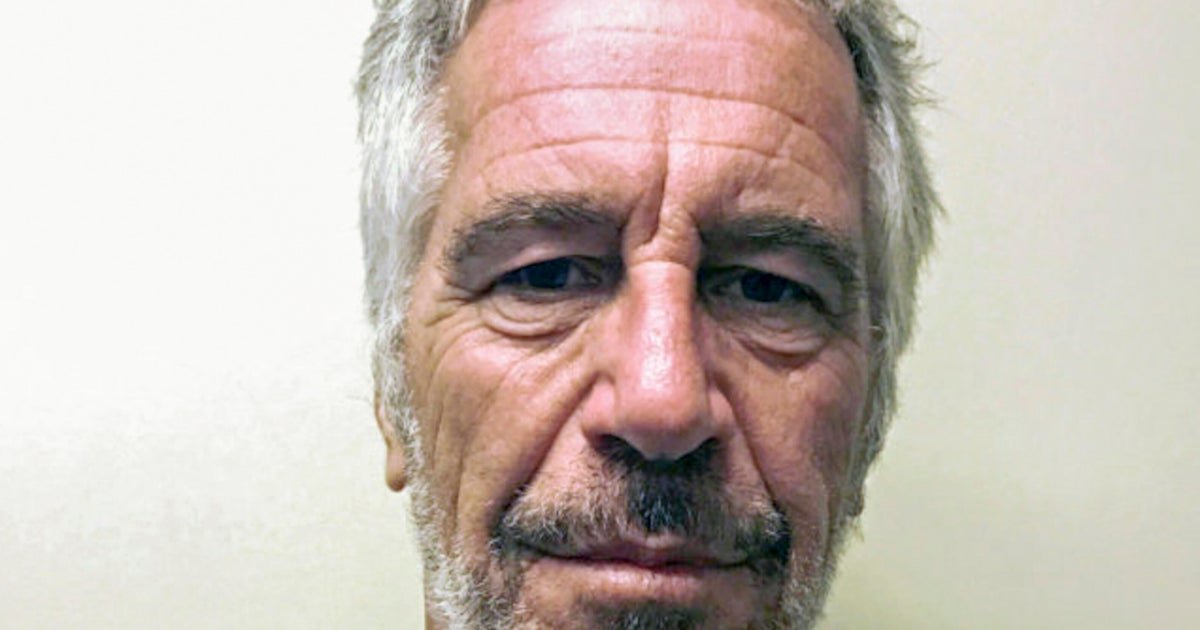
A top pathologist who reviewed Jeffrey Epstein’s autopsy records plans to present findings that call into question the official conclusion that the disgraced sex abuser’s death by hanging was a suicide, according to Epstein’s brother.
“They looked at this whole thing, they looked at it scientifically, they truly investigated this,” Mark Epstein told CBS News Friday.
Michael Freeman, a professor who is editor-in-chief of the Journal of Forensic and Legal Medicine, plans to publish his research and the New York City Medical Examiner’s autopsy files — which he obtained from Mark Epstein — after presenting his findings at the University College London on Nov. 16.
Mark Epstein told CBS News Friday that Freeman’s analysis bolstered his belief that his brother’s death required a deeper investigation.
“The cause on Jeffrey’s original death certificate — they further studied it in detail; this kind of study hasn’t been done before,” Mark Epstein said. “If this kind of study had been done before, they wouldn’t have come up with a suicide conclusion.”
“This report was not done on my behalf, they did this on their own volition,” he added.
Freeman’s review highlights several details that make Epstein’s death investigation “unique” for a suicide case, including that there were no photographs of Epstein’s body at the scene of his death and the ligature used wasn’t preserved or examined. Ligature refers to the rope or other material used to choke or bind a person. In Epstein’s case, according to investigators, bed sheets were used.
Freeman performed “a biomechanical analysis” of the ligature pattern and reviewed what he described to CBS News as “images that show injuries unaccounted for by the medical examiner.” For now, he has declined to describe his conclusions. The Times, a British newspaper, first reported on Freeman’s planned presentation.
“The death can only be a suicide or a homicide, and the lecture will describe the weight (of) evidence for both explanations,” said Freeman, a professor at the Oregon Health & Science University School of Medicine and the Netherlands’ Maastricht University Medical Center. Freeman’s previous work includes advising an audit of Maryland’s medical examiner office.
Freeman’s review comes as the federal Epstein Files Transparency Act has fed a worldwide fascination with Epstein and his circle of elite, wealthy power players who socialized with him even as he became notorious for allegations of sexual abuse. Epstein died in jail in 2019, while facing federal charges for sex trafficking of minors.
The act, passed in 2025, required the Department of Justice to release its voluminous investigative records into Epstein and those in his orbit.
In May, a U.S. district judge ordered the release of an apparent suicide note from an incident less than a month before Epstein’s death. The note had been filed and sealed in May 2021 as part of a murder case involving Epstein’s former cellmate, Nicholas Tartaglione. It was released in response to a filing by The New York Times.
Tartaglione, a former police officer convicted of killing four people, claimed in a podcast interview that he found the note in a book the morning after Epstein’s death, and he gave it to his lawyers.
The scrawled note appears to read: “They investigated me for month — found nothing!!! So 15 year old charges resulted.” The note also includes the phrases “time to say goodbye” and “No fun — not worth it!!”
CBS News has not independently verified the note.