
Pakistan on Thursday expressed “disappointment” with the European Union’s (EU) recent report that pointed out issues in Pakistan’s compliance with its commitments under the Generalised Scheme of Preferences Plus (GSP+).
The report was issued as part of the European Commission’s global assessment of the GSP during the 2023-2025 period. It said Pakistan had “regressed in a number of areas while positive change was limited”.
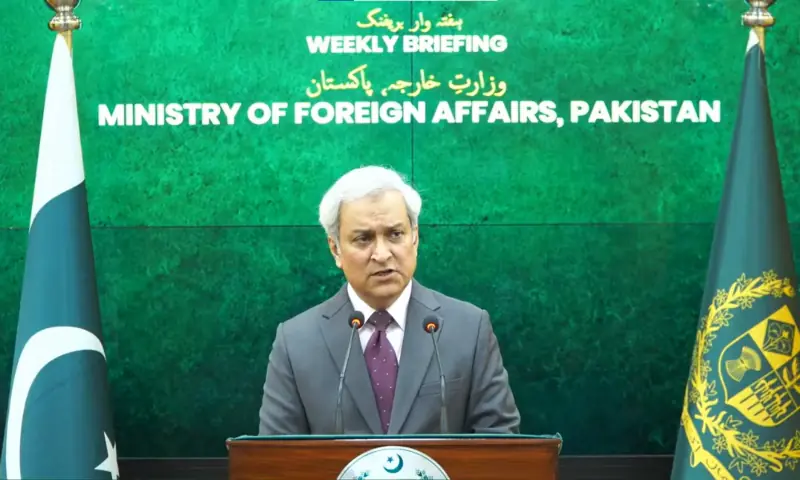
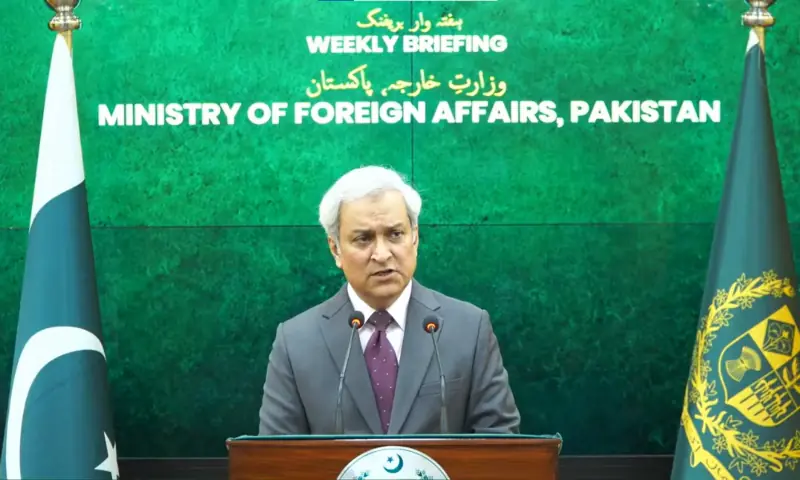
Responding to a query during a weekly press briefing on Thursday, Foreign Office (FO) spokesperson Tahir Andrabi appreciated the report’s “acknowledgement of Pakistan’s legislative progress” and its continued compliance with 27 international conventions under the GSP+.
“Nevertheless, I would be remiss if I do not express disappointment with the assessment, with the report’s overall narrative which does not present sufficiently balanced pictures of Pakistan’s performance,” Andrabi added.
He said the EU report “understates the breadth of reforms undertaken since Pakistan joined GSP+ in 2014” and “places disproportionate emphasis on the lower-than-desired progress in a few areas”.
At the same time, the FO spokesman affirmed that GSP+ remained “central to Pakistan’s economic relationship with the EU, supporting exports, employment, women’s economic participation, poverty reduction and broader economic development”.
He observed that GSP+ was a “mutually beneficial arrangement in that aspect”.
“We will remain constructively engaged with the European Commission and other EU institutions and remain committed to the effective implementation of international conventions underpinning the GSP framework,” Andrabi affirmed.
He highlighted that beyond GSP+, Pakistan’s EU cooperation extended to development, migration, counterterrorism, regional stability, climate resilience, connectivity and many other areas.
FO ‘completely rejects’ Amnesty report on Kabul strikes
The FO spokesperson also “completely” rejected an Amnesty International report released on July 21 that claimed that Pakistan targeted the Omid Rehabilitation and Treatment Centre in Kabul on March 16, resulting in a large number of civilian casualties.
Responding to a question, Andrabi said, “We completely reject the allegations made by Amnesty International.”
He termed it “unfortunate that such serious allegations have been presented without any credible evidence”.
The FO spokesperson asserted: “Any military strikes by Pakistan were undertaken in exercise of its right to self-defence under principles of necessity and as a measure of last resort and directed only and exclusively against terrorists and their logistical support bases in Afghanistan.”
He maintained that Pakistan’s “response was proportionate to the level of threat while strictly adhering to the principle of distinction, precaution and proportionality”.
“The scale and scope of this action reflected restraint, particularly in light of the severity and frequency of terrorist attacks faced by Pakistan. Pakistan rejects any insinuation in this regard otherwise.”
Both the government and the military had asserted that Pakistani forces had targeted an ammunition and drone storage site in the airstrikes conducted on the night of March 16.
Andrabi called on Amnesty and the international community to “direct rigorous scrutiny towards the Taliban regime’s continued patronage of terrorist groups” and to “address the root causes that this Amnesty International report has conspicuously failed to address”.
He further urged the international community to hold the Afghan Taliban regime accountable for its failure to uphold its obligations under the relevant United Nations Security Council resolutions and its commitments under the Doha agreement to “prevent Afghan soil from being used as a launch pad for terrorism”.
Andrabi declared that Pakistan reserved the right to “take all necessary measures in order to safeguard its sovereignty [and] territorial integrity, and safety and security of its people”.
“No responsible state can remain passive when its civilians and security forces are repeatedly targeted,” he emphasised.
The FO official said the Taliban regime continued to “maintain a permissive environment for a range of terrorist organisations, including the Tehreek-i-Taliban Pakistan (TTP), the Baloch Liberation Army (BLA) and other affiliates”.
He added: “The freedom to undertake terrorist activities allowed to these listed organisations, their access to bases and sanctuaries on Afghan soil, as well as ability to recruit, finance and execute cross-border attacks, constitutes a serious threat to regional peace and security.”
Noting that such attacks had killed and injured “thousands of innocent Pakistani citizens”, Andrabi asserted they were “planned, financed, supported and carried out from Afghan soil all under the watch and patronage and active facilitation by the Taliban regime”.
In the past few years, Islamabad has repeatedly urged the Taliban administration in Kabul to dismantle terrorist sanctuaries on Afghan soil that are used for attacks in Pakistan. Officials say those appeals have gone unheeded.
More to follow