
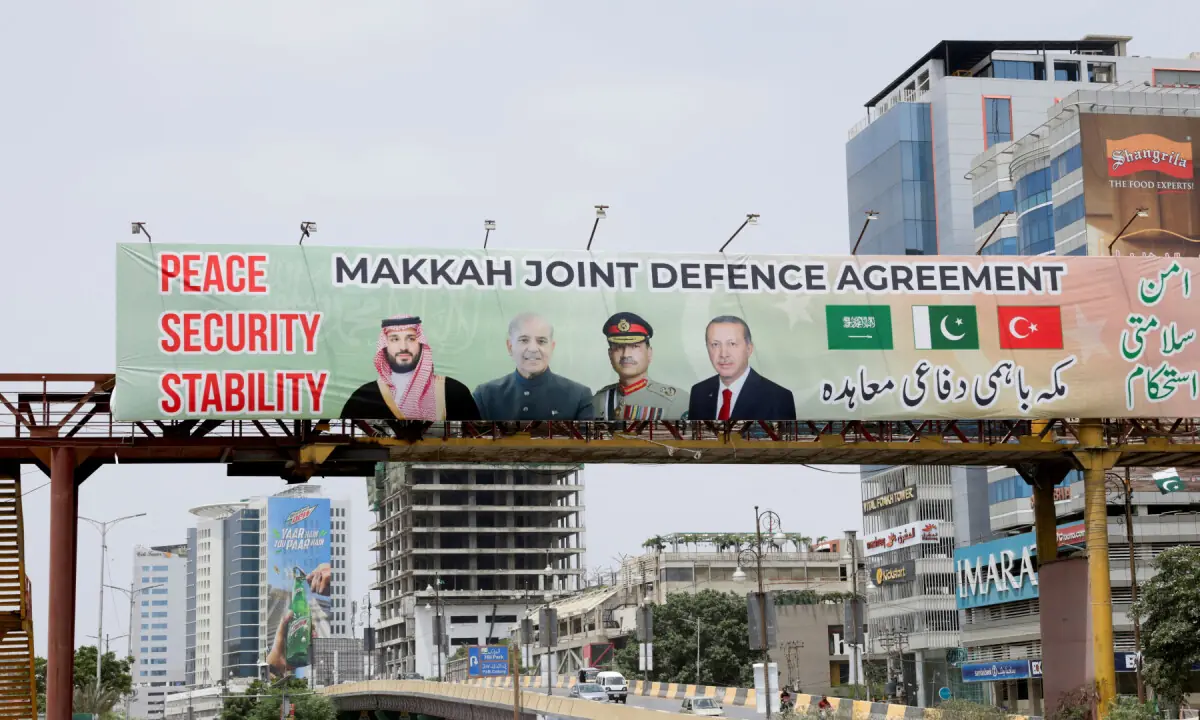
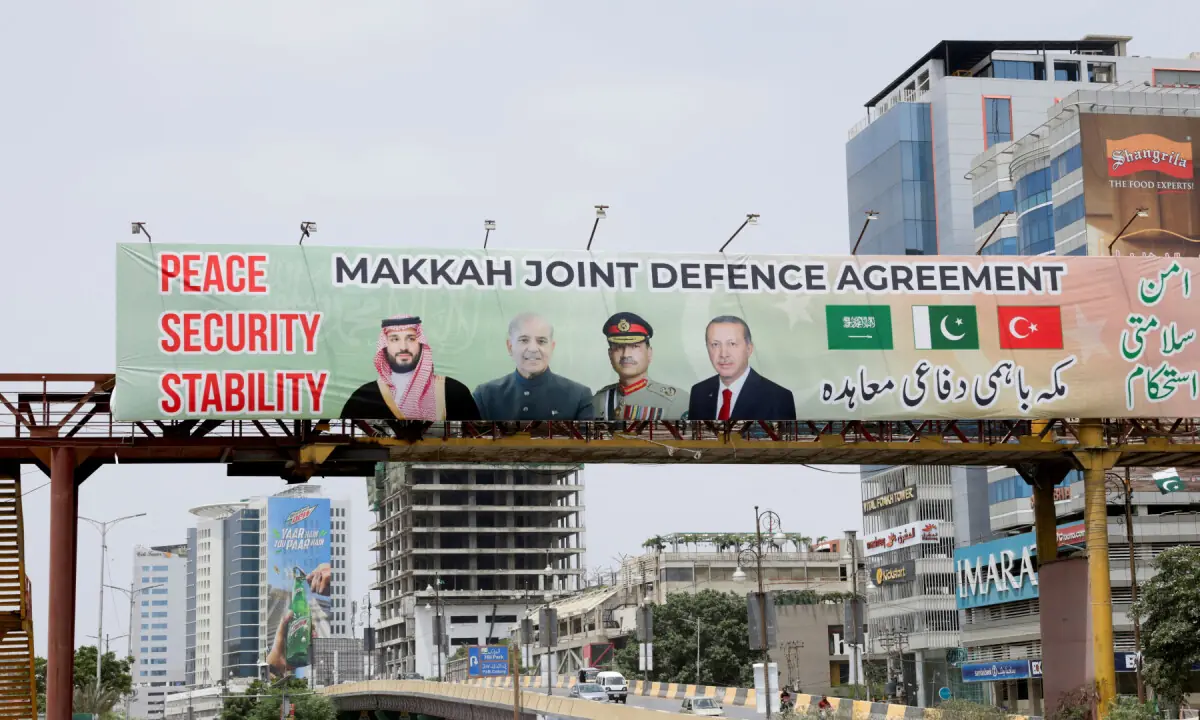
Iran’s foreign ministry said on Monday that the defence pact signed last week between Pakistan, Saudi Arabia and Turkiye was “a sign of a change in the perception” of regional countries towards the United States.
The joint defence agreement, signed in Makkah on Friday, aims to strengthen collective deterrence and empowers its signatory states to treat an attack against one of them as an attack against all of them.
“This development is a sign of a change in the perception of the countries of the region,” ministry spokesperson Esmaeil Baqaei said while responding to a query during a weekly press briefing on Monday.
“Considering the developments of the last two to three years, the countries of the region have realised that security is not a commodity that can be bought from false security brokers,” Iran’s state media quoted him as saying, referring to the United States.
Baqaei further said that there was “no reason to worry that this treaty will be against Iran”, highlighting Iran’s deep religious, historical and civilisational ties with Pakistan, Turkiye and even Saudi Arabia.
“This development is an important sign that the countries of the region have concluded that they cannot rely on and trust the claim of security provided by the United States and some other actors outside the region, and they are attempting to try another method; by relying on their own capabilities and perspectives,” IRNA quoted Baqaei as saying.
“Any plan that is based on the geopolitical and historical realities of the region, is comprehensive and inclusive, and correctly identifies the enemy and the threat, has a chance of helping to strengthen security and prevent instability and abuses by the Zionist enemy and its allies,” he added, referring to Israel.
In response to a question about Iran’s willingness to possibly join the joint pact, Baqaei said Iran has always “emphasised pursuing security mechanisms based on cooperation between regional countries” and “free from the influence and destructive intervention” of foreign actors.
“Those plans still exist and can certainly be updated in light of developments,” the spokesperson added.
“We are in close contact with neighbouring countries and regional countries, and we hope that all countries will learn from the developments of the last two or three years and adopt the best path to strengthen the region’s collective security,” he said, according to IRNA.
Asked about Pakistan’s invitations to Parliament Speaker Mohammad Bagher Ghalibaf and Foreign Minister Abbas Araghchi to visit Pakistan, Baqaei said, “This visit will take place whenever the time is right. Bilateral relations are mainly considered.”
He added: “The relationship between Iran and Pakistan is a very important one. In the last seven or eight months, it has become even more important than before, for various reasons.”
On Sunday, Deputy Prime Minister and FM Ishaq Dar said that the Makkah Joint Defence Agreement remained “open to any country in the region” willing to uphold its fundamental principles after the Turkish foreign minister said Egypt could be joining the pact.
Dar said the pact was the “culmination of years of discussions and coordination”, adding that it was “purely defensive” in nature.
“It is not targeted against any country and its sole purpose is to further strengthen our ongoing efforts towards peace, stability and prosperity in the wider region.”
The deputy PM clarified that the pact did not abrogate or replace any existing bilateral or multilateral agreements between the signatory countries, or with other countries or organisations.
Dar speaks with Kuwait FM, others on pact
Separately, DPM Dar received a phone call from Kuwait’s Foreign Minister Sheikh Jarrah Jaber Al-Ahmad Al-Sabah, wherein the latter felicitated the former on the Makkah Joint Defence Agreement, the Foreign Office (FO) said on Monday.
According to the FO, the two dignitaries spoke late on Sunday and also “exchanged views on the regional situation, including occupied East Jerusalem”.
They also discussed bilateral relations between the two countries and “matters of mutual interest, including the follow-up to FM Jarrah’s recent visit to Pakistan and further enhancing cooperation and investment in key sectors”.
“The two sides agreed to remain closely engaged,” the FO added.
The deputy premier also shared the contours of the pact with Democratic Republic of the Congo (DRC) President Félix-Antoine Tshisekedi and former Guinea-Bissau president General Umaro Sissoco Embaló.
In a joint call with them late last night, Dar shared the agreement’s “significance for strengthening strategic cooperation and contributing to regional peace, stability and security”, FO said.
Dar and Tshisekedi also exchanged views on Pakistan-DRC relations and agreed on the importance of further strengthening bilateral cooperation, including through high-level exchanges.
DPM Dar had also spoken to Canadian Foreign Minister Anita Anand a day ago.
“The two exchanged views on the regional situation, including the recently signed Makkah Joint Defence Agreement between Pakistan, Saudi Arabia and Turkiye,” the FO said.
It added that Dar shared the “essence of the agreement” and the “joint resolve of the three countries to contribute to regional peace, stability and security”.