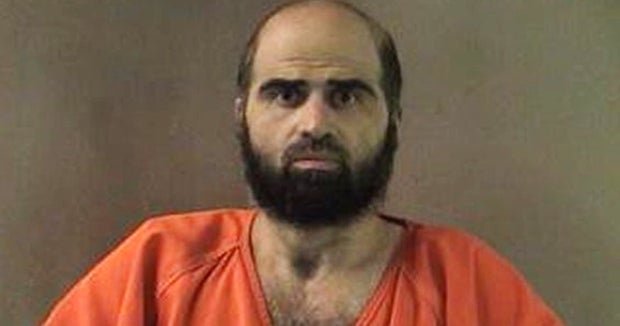
The U.S. military plans to livestream the execution of Nidal Hasan, the ex-Army major who was convicted of the 2009 killing of 13 people at Fort Hood, when he faces a firing squad on Dec. 3, a Pentagon official said.
Defense Secretary Pete Hegseth said earlier Thursday the Pentagon planned to make the execution public.
“He’s gonna get a firing squad of soldiers, as it should be,” Hegseth told Jack Posobiec on Real America’s Voice. “We’ll make sure that people are able to watch it, that it’s public — because people need to understand that there’s serious consequences for these types of things.”
Hegseth said the early December execution will take place at Fort Hood at 1 p.m.
Earlier this week, the Trump administration approved the plan to execute Hasan. Chief Pentagon spokesman Sean Parnell said on social media the plan to use an Army firing squad was recommended by Hegseth and approved by President Trump.
While executions are sometimes witnessed by small groups of people, including reporters and victims’ family members, it is virtually unheard-of in recent history for an execution in the United States to be viewable by the general public.
CBS News has reached out to Hasan’s attorney for comment.
A former Army psychiatrist, Hasan was convicted of murdering 13 people and injuring more than 30 in a 2013 court-martial. Hasan acknowledged at trial that he was responsible for the shooting, claiming he opened fire on fellow members of the Army in an attempt to protect Islamic insurgents from U.S. military forces. He was sentenced to death.
Hasan’s case could mark the military’s first execution of an American service member since 1961, when a soldier was hanged for raping and attempting to murder an 11-year-old girl.
It would also mark a rare use of a firing squad. Hegseth said “it hasn’t been since World War II since we’ve done that,” pointing to the military’s 1945 execution of Pvt. Eddie Slovik for desertion.
In state civilian court, the execution method was used in South Carolina three times last year, marking the country’s first firing squads since 2010. The federal government typically uses lethal injection in civilian death penalty cases, though the Justice Department said earlier this year that officials should consider other methods, including firing squads and electrocution.
The decision by Hegseth comes after a lengthy appeals process for Hasan. He chose to represent himself at trial, and in an unusual course of events, he clashed with his own court-appointed standby attorneys, who worried that Hasan was intentionally seeking the death penalty.
Hasan asked the Supreme Court to review his case in 2024, arguing the judge had violated his right to a public trial by clearing the public from the courtroom before discussing some of his issues with the attorneys. The high court declined to take up the issue last year.