Flights were halted at Ronald Reagan National Airport for several hours on Tuesday, leading to over a hundred canceled flights and cascading delays, due to security measures meant to protect the Iraqi prime minister during his visit to Washington, D.C., during the war with Iran, sources familiar with the situation told CBS News.
Commercial flights were postponed from taking off or landing at the D.C.-area airport from 11 a.m. ET until around 3 p.m. Over 300 flights were delayed and at least 126 flights were canceled, according to the flight tracking site FlightAware.
The disruptions took place in one of the most congested and tightly controlled airspaces in the country, where hundreds of daily commercial flights contend with military traffic and snake around federal buildings in Washington and northern Virginia.
White House and Federal Aviation Administration officials shared timing updates during Iraqi Prime Minister Ali al-Zaidi’s visit in an effort to minimize the impact, a senior administration official said. They allowed some of the planes that were holding in the air to land at DCA and those on the ground to depart, the official said.
Spokespeople for the FAA and Department of Transportation declined to comment.
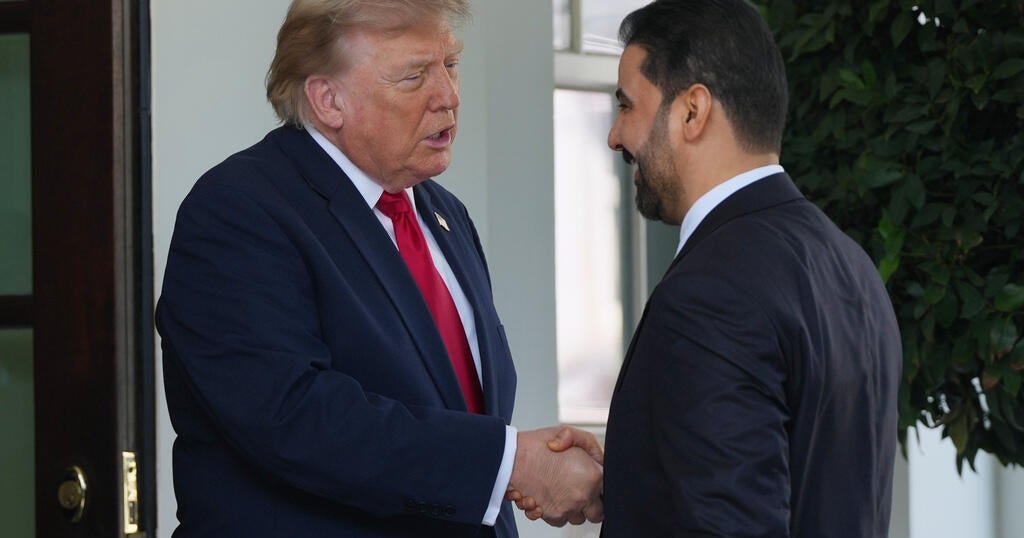
President Trump hosted al-Zaidi, who was elected in May, to discuss the future of U.S.-Iraqi bilateral relations during his first visit to the United States.
Mr. Trump extended their meeting by inviting the Iraqi leader to lunch. “It wasn’t scheduled, but we are going to do it on the fly because we have a tremendous chemistry together,” Mr. Trump said Tuesday morning.
Al-Zaidi’s motorcade left the White House for the Pentagon at 1:30 p.m., later than expected, with a security helicopter circling overhead, traveling through DCA airspace.
He became prime minister after Mr. Trump threatened to pull U.S. support for Iraq if a candidate who was seen as overly close to Iran won. The Iraqi leader has a delicate relationship with neighboring Iran, which has significant influence within Iraq. The country’s government has pushed for Iraq’s powerful pro-Iranian militias to disarm by Sept. 30, when U.S. troops are scheduled to leave.
The U.S. war with Iran, now in its fourth month, has prompted security concerns both in the Middle East and domestically. Some counterterrorism experts have cautioned that Iran has sought to take action in the U.S. in the past, sometimes tapping into a network of U.S.-based surrogates to attempt kidnappings and murder-for-hire plots against regime opponents.
The federal government has also warned of non-Iran-related threats, particularly in light of the recent assassination attempts against Mr. Trump.
Defense Secretary Pete Hegseth invited certain members of Congress to the Pentagon Tuesday night to brief them on the military’s proposed budget, sources familiar with the matter told CBS News. The $1.5 trillion budget includes money for weapons and military capabilities, which supporters argue would help the U.S. deal with critical threats.
Last month, the FBI said it foiled a plot to attack a UFC fight at the White House using snipers and explosive-laden drones, later indicting eight people. Sources told CBS News last month that no actual drones had been recovered, and the idea of using drones in the alleged plot was believed to still be in the discussion-and-research phases.