A deepening water crisis in the Western United States has reached an impasse as disagreement among affected states is grinding progress to a halt, and the well of potential solutions is close to running dry.
The nation’s two largest reservoirs — Lake Mead and Lake Powell on the Colorado River — have fallen to their lowest levels on record. It’s a moment of reckoning in the drought-stricken West as seven states can’t agree on how to share the rapidly shrinking water supply.
The Colorado River is a lifeline for the region, and it’s the line dividing the upper basin states, Colorado, Wyoming, Utah and New Mexico, and the lower basin states, California, Arizona and Nevada.
Kelly Shannon McNeill, the managing director of LA Waterkeeper, an organization that serves as a water watchdog, told CBS News that California and other lower basin states have cut use of the Colorado River by nearly 20% since 2015. But the upper basin states “have gone in the opposite direction,” McNeill said.
“In the last year alone, they’ve increased their use over the same period and say they can’t afford cuts. And so this is really, you know, it’s about political will,” she said.
RJ Sangosti/MediaNews Group/The Denver Post via Getty Images 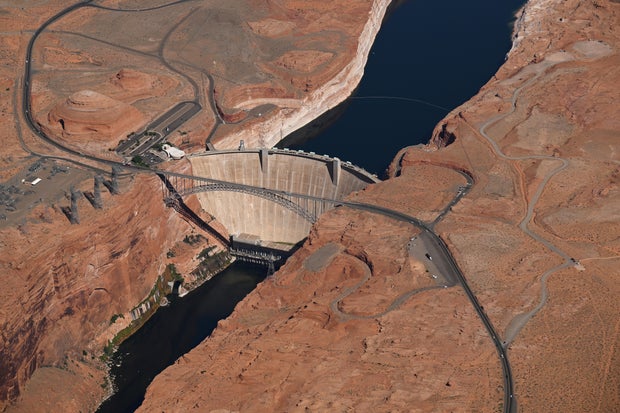
After years of failed negotiations between the states, the Trump administration is now poised to impose sweeping cuts.
California, Arizona and Nevada have offered to cut their use by about 1.6 million acre-feet, or roughly 500 billion gallons, a year for the next two years.
However, federal officials who control the water flow are considering cuts nearly twice that amount. The major cuts would likely mean higher costs for cities trying to secure water, tighter restrictions on outdoor water and significant changes for farmers who use the majority of the river’s supply.
“I would urge those people living in those states to contact their elected representatives and their negotiators at the table, and really urge them to come to the table … and come up with some sort of agreement,” McNeill said.
Water in the Colorado River begins as snow in the Rocky Mountains, but a warming climate has led to less snowpack and less snowmelt feeding the river each spring. Population growth in the region has also amplified the crisis.
Ethan Miller / Getty Images 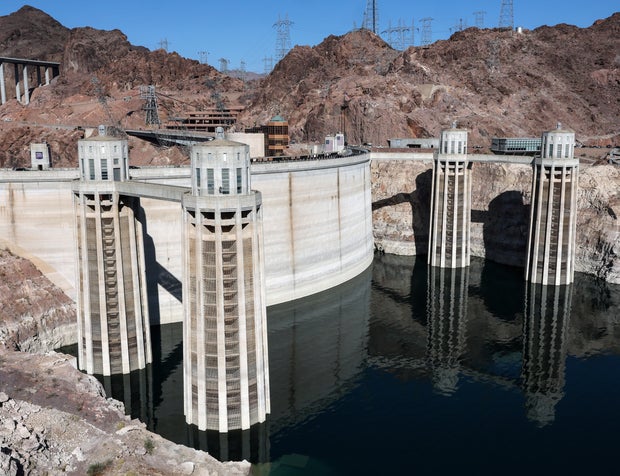
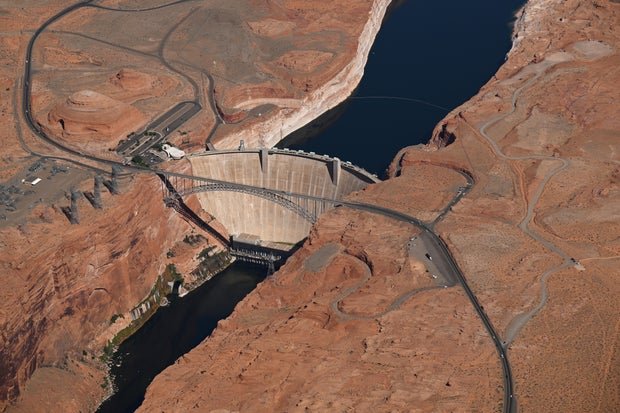
If the water in Lake Powell falls just 33 more feet, the reservoir will no longer meet the water levels needed to generate hydroelectric power, meaning the water can’t move through the dam into the Colorado River.
And with both Lake Mead and Lake Powell at less than 30% full, residents can’t afford for decision makers to waste time.