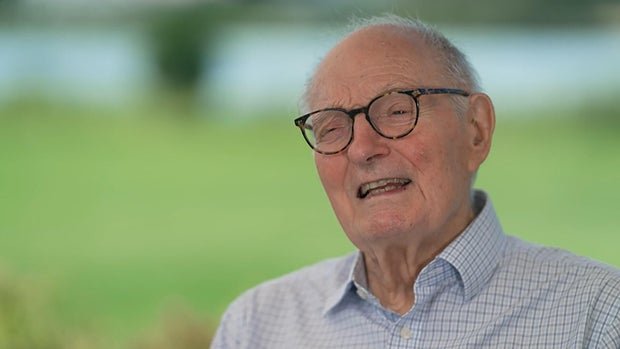
Is it even possible to choose a favorite Alan Alda character? How about Senator Arnold Vinick on “The West Wing”? Or lawyer Jack Burroughs in “The Four Seasons”? And, of course, “Hawkeye” Pierce, the sarcastic Korean War combat surgeon, on “M*A*S*H”?
For his work on “M*A*S*H,” which aired on CBS for 11 seasons beginning in 1972, Alda won five of his six Emmy Awards for acting, writing and directing.
“I have doctors coming up to me on the street all the time telling me that seeing me in the show made them want to become a doctor,” Alda said. “Not a single one said it made them want to become an actor!”
CBS News 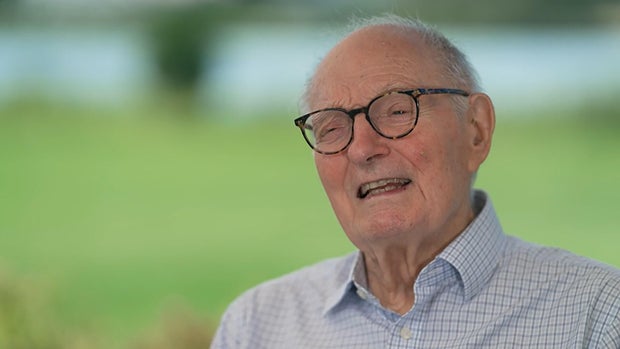
Long before playing Pierce, Alda – now 90 – was on the other side of the stethoscope. As a seven-year-old he had polio, before there was a vaccine. “My father had just gotten a huge part in a movie, playing George Gershwin,” he said. “And about a week after he started shooting, I got polio. And he and my mother had to administer the treatment, which was almost-scalding hot packs of wool on every limb. So, they were practically torturing their kid. I remember thinking it was hard on them.”
As a boy, Alda studied his father Robert Alda’s performances in vaudeville and burlesque, and also on Broadway, when Robert starred in the original cast of “Guys and Dolls.” “I stood in the wings and watched that every Saturday,” Alan said.
But Lady Luck dealt the family a difficult hand. His mother, Joan, a former beauty pageant winner, was complicated. “My mother was mentally ill, had schizophrenia and was paranoid,” Alda said. “So sometimes the communication would be about the crack in the wall was where they had a camera taking pictures of us. I think that contributed a lot to tools I later had, trying to figure out what’s real and what’s not real. I had to pick one reality and try to stick with that. … It made me more observant. And I think it even helped – I’m just realizing this for the first time in this moment! – I think it made me a little more curious.”
He’s been especially curious about human connection, something he fostered on the set of “M*A*S*H.” “We didn’t go back to our dressing rooms between shots,” he said. “It was just, like, an hour or two hours where they light the new set, we stayed in our chairs in a circle and made fun of one another and laughed. And that connection that we had, we carried with us onto the set.”
Which had a huge impact on viewers. More than 100 million people watched the series’ final episode. “They think 106. But I think it was probably more. Not that I’m greedy!” he laughed.
For years, Alda has been concerned that scientists and health care professionals often use technical language that’s hard for the general public to understand. With that in mind, in 2009, New York’s Stony Brook University founded the Alan Alda Center for Communicating Science. Back in 2013, our own Tracy Smith watched Alda use methods from his own acting experience, including improvisation.
He said, “Improvisation really puts you in touch with the other person, and that’s when I realized the value of connection.”
Connecting is one of Alan Alda’s superpowers. Since 2018, on his podcast “Clear+Vivid,” he’s been interviewing guests like Paul McCartney, Michael J. Fox, Noah Wyle, and recently, Joy Behar.
CBS News 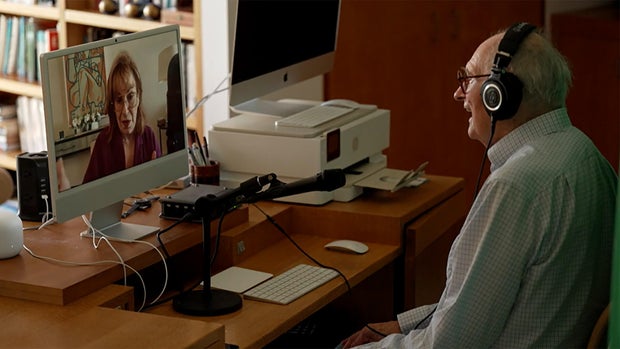
To Alda, connecting with people means being clear and honest, which is why he will openly discuss his Parkinson’s disease. “I had a symptom, which at the time was not that well-known: Acting out your dreams,” he said. “I had a dream that somebody was attacking me. And I picked up a sack of potatoes and threw it at ’em. What I was really doing was throwing a pillow at Arlene, my wife.”
At the time he had no other symptoms: “I had no twitch, no tremor, no problems with my voice.”
He was 79. A few years later, Alda decided to reveal the diagnosis. “I really think reality is my friend,” he said. “I don’t want to wish it away. I can’t wish it away. I can’t hope for a better future. I gotta accept what is.”
There’s currently no cure for the neurological disorder, but there are medications and other treatments. “I don’t let Parkinson’s define me,” he said. “It’s not who I am. It’s just a hobby.”
Which brings us to what Alda considers the importance of a sense of humor: “Very important, because the best way to deal with anything that’s a little bit of a problem is to find out what’s funny about it and laugh at it.”
But what is funny about Parkinson’s? “I’ll be at the computer keyboard writing an email, and Dr. Parkinson is moving my hand all over the screen. I have the mouse, and he’s eliminating things and he’s deleting things that I need,” Alda laughed. “Once in a while I get frustrated. But I find what makes me laugh about it, and then I go tell Arlene. Laughing first brought us together. We were invited to dinner at a friend’s house. And Arlene was sitting at one end of the table, and I was sitting at the other end. And I noticed that she was laughing at my jokes. So already I was smitten. In March, we’ll be married 70 years.”
They have three daughters and eight grandchildren.
Alan Alda says he feels really good, even if Arlene has to help button his shirt in the morning, which he admitted he hated. “Of course, I feel that from time to time,” Alda said. “I do hate it, but the only thing that’s helpful is: what haven’t I tried? And pretty soon, you get the feeling, ‘If I keep looking for new ways to try this, I’ll get a solution.’ It’s a puzzle. Will I be able eventually to put my socks on? The last time I put my socks on was a tremendous moment to celebrate!”
WEB EXCLUSIVE: Watch an extended interview with Alan Alda (Video)
Story produced by Jay Kernis. Editor: Carol Ross.
For more info: