
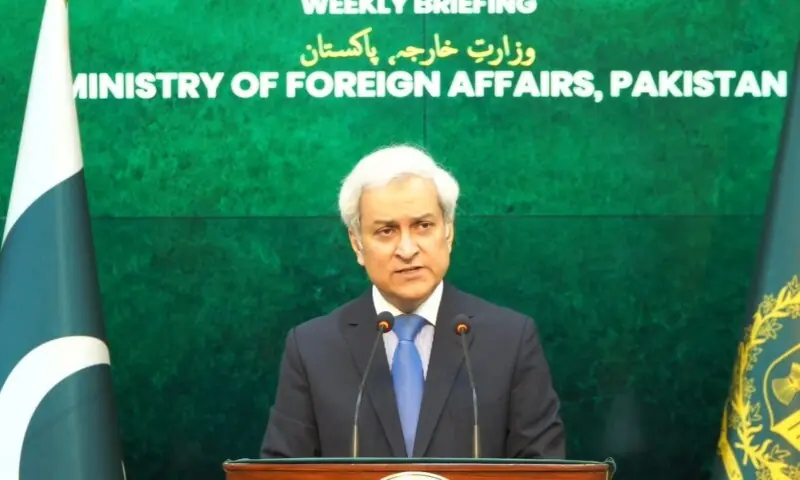
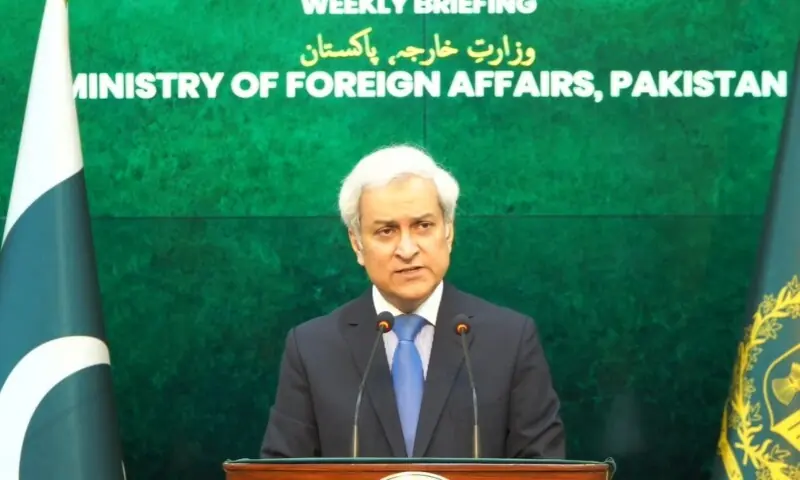
The Foreign Office (FO) said on Thursday that Pakistan was doing its “utmost” to bring the United States and Iran back to the negotiating table under the Islamabad memorandum of understanding (MoU) signed last month.
Addressing a weekly press briefing, FO spokesperson Tahir Andrabi said Pakistan noted with concern that the security situation in the Middle East “remains precarious despite the relative calm of the past few days, which had rekindled hopes that this positive development, this calm, would consolidate into a durable and fully respected ceasefire and pave the way for dialogue”.
Andrabi reiterated Pakistan’s support for dialogue and diplomacy, maintaining that it remained the “only viable path forward”.
“We welcome all efforts aimed at sustaining cessation of hostilities and resumption of dialogue between Iran and the US,” he said, adding that Pakistan remained engaged and will continue to do so.
“Let me add that the negotiations between parties are ongoing to normalise the situation, particularly the situation in the Strait of Hormuz, as well as to de-escalate,” he stated.
He added that Pakistan was doing its “utmost” to bring the two parties back to the Islamabad MoU “so that all irritants can be removed in the light of the spirit of the agreement and the Pakistan-Qatar joint statement on June 22”.
Andrabi urged both the US and Iran to exercise “maximum restraint and fully adhere to their commitment to resume technical-level talks” in line with the Islamabad MoU and the Pakistan-Qatar joint statement.
The MoU between the US and Iran was signed on June 18 after weeks of intensive diplomacy. It was aimed at reopening the Strait of Hormuz and ending the Middle East conflict — which began with US-Israeli strikes on Iran in February — after a further 60 days of negotiations.
However, renewed hostilities erupted on July 7, when Iran attacked commercial shipping in the Strait of Hormuz, including a Qatari liquefied natural gas tanker, accusing the US of violating the understanding. The attack prompted multiple waves of US strikes on Iranian military targets.
The conflict has intensified with the Houthi rebels in Yemen imposing a naval blockade on Saudi Arabia, extending the war to a second major shipping chokepoint.
On Wednesday, the war spread across new fronts as explosions hit a natural gas loading port in Egypt and a US-owned floating storage tanker was reportedly struck by a drone, while the US and Saudi Arabia carried out joint strikes on Iran-backed paramilitary groups in Iraq in retaliation for attacks on US troops and Saudi oil targets.
On Thursday, after nearly a week-long pause, the US again struck Iran in retaliation for Tehran targeting American bases in Jordan.