
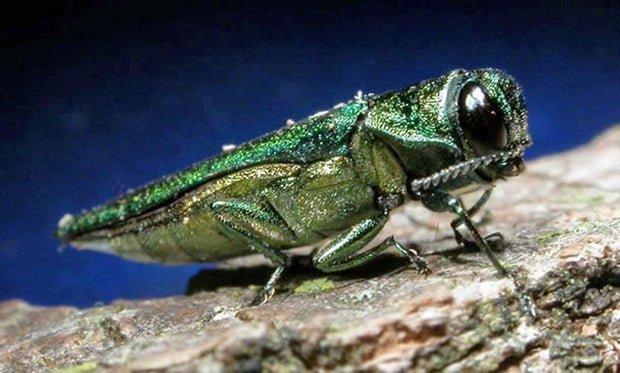
A tiny Asia-origin beetle that has devastated ash forests in North America has been detected in the European Union for the first time in Hungary and Slovakia, authorities said.
Slovakia’s Agricultural Central Control and Testing Institute, based in Bratislava, said that 18 feared emerald ash borers were found this month in the Streda nad Bodrogom district in the east of the country.
Two adult emerald ash borers were found in June in a trap in the Beregsurany forest, near Hungary’s frontier with Ukraine, Hungary’s NEBIH food safety office said in a statement.
The office said the emerald ash borer was “one of the most serious pests affecting ash trees” and “has already caused significant ash tree mortality in North America and Eastern Europe.”
Hungarian authorities have ordered more traps to be laid and better monitoring to assess the spread of the beetle, which can grow up to half an inch long when an adult.
AP Photo/Minnesota Department of Natural Resources 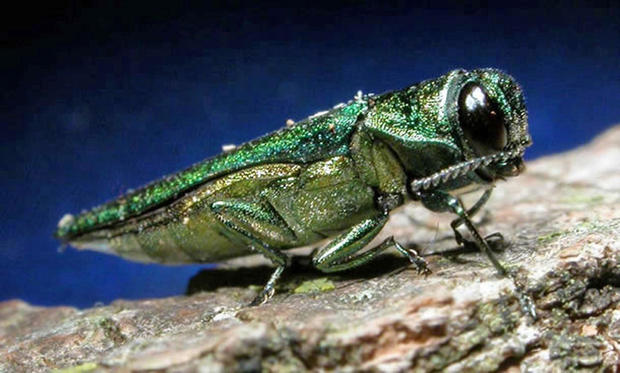
NEBIH has called on the public to report any trees with suspicious symptoms.
Beetle is a “good flyer and spreads naturally”
The beetle has killed or damaged tens of millions of ash trees in North America, according to the U.S. Department of Agriculture, which has detected the pest in 38 states and D.C. It was first detected in North America in 2002 in southeast Michigan.
“The beetle is well-suited to our climate, is a good flyer, and spreads naturally,” the USDA says.
The pest was first spotted in Minnesota in 2009, which has since launched a program involving releasing special species of wasps to target the invasive beetle. The small wasps target the emerald ash borer at various stages of its life cycle without harming other species, CBS News Minnesota reported.
A 2025 study also found certain fungi in Minnesota can kill the invasive emerald ash borer beetle.
The beetle has been spotted in other states as well. The emerald ash borer was detected in Denver for the first time last summer, CBS News Colorado reported, and it reached North Dakota in 2024.
Many European countries say they have emergency plans ready in case it is detected on the continent.
Hungary has called for the presence of the beetle to be put on the agenda of the next EU agriculture ministers’ meeting.
“We are aware of the gravity of the situation and are doing everything possible to prevent this pest from becoming permanently established in Hungary or turning into a plant health issue for the whole European Union,” Hungary’s Agriculture Minister Szabolcs Bona told the Agroinform.hu farm news website.