

A day after Defense Secretary Pete Hegseth announced that U.S. service members over the age of 30 will be annually screened for “testosterone deficiency,” doctors are expressing skepticism of the program and its goals.
Hegseth said all service members over 30 will be screened as part of their regular health assessments, and that younger ones will have the option of being tested to ensure that they “have the right testosterone levels to operate at your absolute best.” He said opting to receive testosterone replacement therapy will be voluntary.
Hegseth has commented frequently on the physical standards of the military, connecting appearance and masculinity to combat readiness. Hegseth did not say what the new policy might mean for female service members, and other details have not yet been announced.
Doctors flagged a range of concerns about the policy, which is likely to be costly to implement. National organizations including The Endocrine Society and the American College of Physicians recommend against general screenings for testosterone levels, which can fluctuate based on age, lifestyle and even the time of day.
“Testosterone in the normal range is not a performance drug,” said Dr. Céline Gounder, CBS News medical correspondent and editor-at-large for public health at KFF Health News. “For a man whose level is genuinely low, replacement can help libido and mood a little. It has not been shown to sharpen thinking, fix fatigue, or make a healthy 30-year-old a better soldier.”
“No link to how masculine they are or feel or look”
Testosterone is a hormone naturally produced by the body. It helps maintain muscle and bone mass, and impacts mood and energy levels. It impacts libido and supports sperm production in men. But it isn’t inherently linked to an increase in strength or capability, said Dr. Marcus Goncalves, director of the Holman Division of Endocrinology, Diabetes, and Metabolism at NYU Langone Health.
“The normal range is from 270 to 900-plus. Putting people on that scale has no link to how masculine they are or feel or look. Somebody could be normal at 350, somebody could be normal at 650,” Goncalves said.
A number of factors can cause low testosterone, Goncalves said, including stress, poor sleep and overexertion. All of these may be common for service members, he said. Researchers have previously found that military training can impact testosterone levels.
But when testosterone levels decrease due to lifestyle factors, the effect is “transient and reversible,” and the hormone rebounds naturally when the situation changes, Goncalves said.
There is no research to show that supplementing temporarily lower testosterone levels results in performance improvement, he added.
Levels of testosterone naturally peak in early adulthood, around the 30- to 40-year-old range, before dropping by about 1% per year, Goncalves said.
Low testosterone can result in fatigue, depression and poor concentration, Goncalves said. But young men have “very low risk of having low testosterone,” he said, noting that the symptoms associated with low testosterone can also be caused by “20 other reasons.”
“When a man in his 30s or 40s has a low testosterone level, it’s usually a signal of something else: extra weight, bad sleep, opioids, chronic stress,” said Gounder. “That describes a lot of military life. Treating the cause is what works. Handing him a hormone treats the number and leaves the cause sitting there.”
Testing is complex — and expensive
Because testosterone levels can vary so much, determining a person’s levels can be difficult. It’s recommended that people be tested in a narrow time window, between 8 and 10 a.m., Goncalves said, when testosterone is typically at its highest point. All reference ranges are calibrated to this time period, he said. Ideally, people should have fasted before undergoing the test.
If a test shows low levels, it should be repeated at least once, he said. Diagnosing low testosterone tends to require multiple appointments and tests over the course of months.
Gounder predicted that the blood draws alone would cost the military “tens of millions of dollars a year.” Follow-up tests, treatment and monitoring will send the price tag soaring further, she said.
“There’s no published analysis showing this is a good use of money, and that should matter for an administration concerned with waste, fraud and abuse,” Gounder added. “The Endocrine Society looked at exactly this question, whether you should screen men for low testosterone, and concluded you shouldn’t. So the military is about to spend real dollars, at scale, on a program the science says isn’t worth doing.”
Risks of testosterone replacement therapy
Testosterone replacement therapy uses anabolic steroids to increase testosterone levels. The steroids can be administered via injection, oral medicine or with a topical gel or patch.
Carolyn Kaster / AP 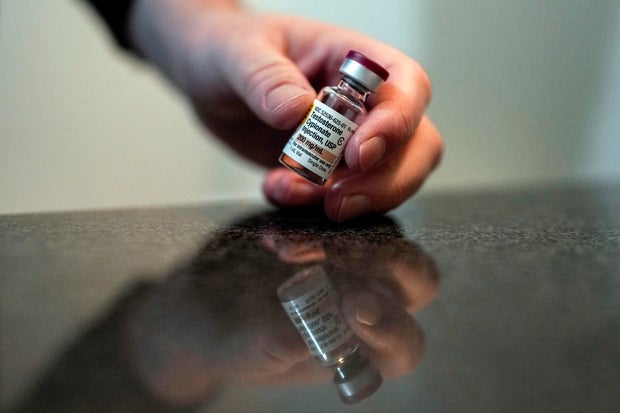
The therapy is known to increase the production of red blood cells. If levels of the hormone rise too high, that can result in an increased risk for blood clots. Those clots can go on to cause pulmonary embolisms and kidney injuries, Goncalves said.
Testosterone replacement therapy can also cause the body to stop producing the hormone on its own, Goncalves said. The testes will shrink and sperm production will drop. For men who are looking to grow their families, this “unintended consequence” can impair fertility, Goncalves said. Increased testosterone can also be converted into estrogen, resulting in breast tissue growth.
Goncalves also noted that the widespread screenings needed to test every service member over age 30 could produce “a very high risk of getting false positive” results, which can “lead to unnecessary medical testing and overtreatment.”
For people who cannot produce enough testosterone due to medical issues like testicular dysfunction, injury or pituitary issues, the benefits of replacement therapy outweigh the risks, Goncalves said. But for people who are already producing an adequate amount of testosterone, there’s “very little evidence to support” the therapy.
“For most men over 30, we don’t have evidence that finding and treating a low testosterone number makes them healthier, stronger or more capable. We do have evidence that it carries risk,” Gounder said. “Launching a mass screening program anyway isn’t following the science.”
The optimization industry
Hegseth’s announcement comes amid a growing trend of wellness influencers and marketers promoting ways to “optimize” a person’s body and lifestyle.
There’s been a surge of interest in peptides, even unregulated ones. Health and Human Services Secretary Robert F. Kennedy Jr. has called himself a “big fan” of the medications, and the Food and Drug Administration, which he oversees, is considering easing restrictions on some.
Meanwhile, testosterone replacement therapy prescriptions in the United States have “more than tripled,” Gounder said, with many of those cases involving “men who were never properly diagnosed.”
“A lot of the trend has been focused on optimizing a normal body,” Goncalves said. “It seems like people are taking it as a given that pushing your levels higher and higher always leads to a better result, and I think we have a lot of examples in medicine where that is not the case.”