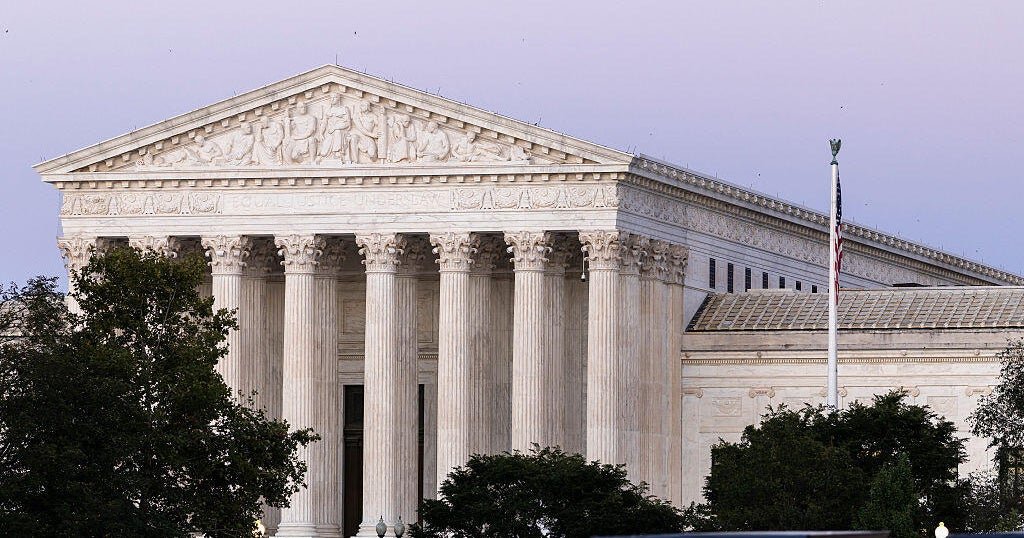
Washington — The Supreme Court on Tuesday temporarily allowed the Trump administration to resume its policy of sending some deportees to countries where they have no ties, while agreeing to hold arguments over the controversial practice.
The high court agreed to pause a February order from a federal district judge that said immigration authorities must give deportees more due process before removing them to so-called third countries. That decision was largely upheld by a federal appeals court earlier this month.
The lower courts said migrants are entitled to notice and the opportunity to challenge their removals before immigration officers attempt to send them to countries that are not their own. But the Trump administration has argued those decisions have prevented the Department of Homeland Security from “efficiently removing aliens,” including those with criminal records.
Justices Sonia Sotomayor, Elena Kagan and Ketanji Brown Jackson said they would have denied the government’s request for emergency relief.
The high court’s decision paves the way for the Trump administration to continue relying on a March 2025 policy that allows officials to send deportees to third countries, without notifying them of the destination, if such nations provide the U.S. government blanket assurances that they will not persecute or torture the deported migrants.
In addition to granting the Trump administration’s request for emergency relief, the Supreme Court said it will hold arguments in the case in December. It asked lawyers for the Justice Department and migrants challenging the third-country-removal policy to be prepared to address several questions, including whether it violates federal law, the Constitution’s Due Process Clause or regulations.
A decision from the court would likely come by the summer of 2027.
James Percival, general counsel at the Department of Homeland Security, cheered the decision and urged people in the U.S. illegally to self-deport.
“In our second Supreme Court victory in less than a week, DHS’s third country removal policy is back in effect,” he wrote on X. “A bad day for criminal illegals and open borders activists alike. It’s not too late to get $3,000 and a flight home.”
Over the past year and a half, the Trump administration has persuaded several dozen countries — mainly in Africa and Latin America — to accept groups of deportees from the U.S. who are citizens of other nations. The arrangements, which have been largely shrouded in secrecy, have allowed U.S. officials to send deportees from countries like Cuba, Colombia and Venezuela to African countries, as well as migrants from Asia and other parts of the globe to Latin American nations.
Some third-country deportees have been sent to notoriously dangerous nations like the Central African Republic and South Sudan. In Liberia, deported men and women from Brazil, Colombia, Guatemala, Honduras and Venezuela told CBS News they only learned they were getting deported to Africa hours before the deportation plane took off — or in the middle of the flight.
The Trump administration’s efforts to remove migrants to third countries are part of a broader immigration crackdown pursued by President Trump in his second term. The Justice Department told the Supreme Court last week that as a result of the lower court decision blocking the third-country removals, the Department of Homeland Security had to cancel a flight to three countries for 70 migrants, some of whom have criminal records.
The administration estimates that the policy has led to the deportations of “thousands” of individuals in recent months, with “thousands more” eligible to be removed to third countries.