
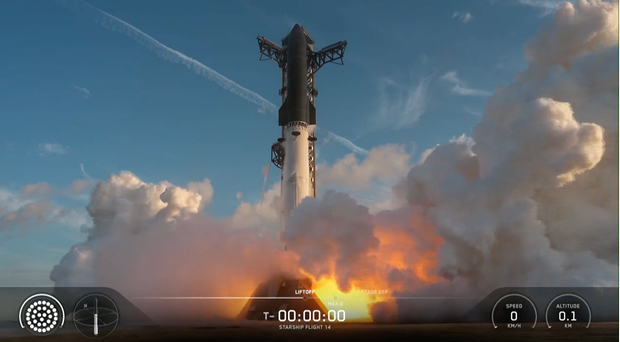
SpaceX launched the company’s Super Heavy-Starship on its first flight to orbit Monday, a major step toward perfecting the world’s most powerful rocket for commercial flights and NASA moon missions.
The Starship upper stage lost an engine during ascent, but after some discussion, flight controllers cleared it to continue on to orbit.
With 13 suborbital test flights behind them, this flight marks a crucial step for both SpaceX and NASA. Getting the Starship into orbit and back would boost confidence SpaceX has a shot at perfecting the system in time to support NASA’s planned Artemis moon landing, using a variant of the Starship, in 2028.
SpaceX 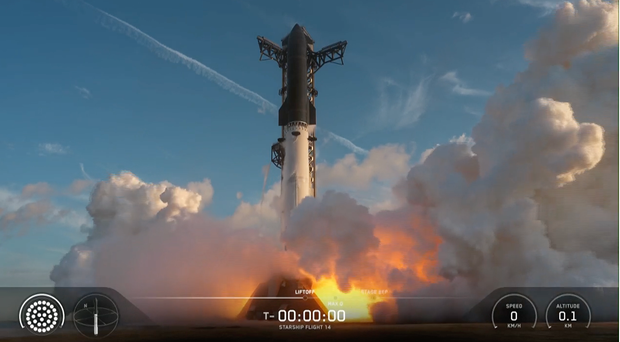
A future moon mission will require multiple Super Heavy-Starship tanker flights to fuel the lander for its flight to the moon before docking with a NASA Orion crew capsule, in lunar orbit, picking up two astronauts and carrying them down to the surface and back.
Getting the Starship safely into orbit will set the stage for follow-on test flights to demonstrate autonomous orbital refueling, a feat never before attempted at the scale required for Artemis moon landing missions.
SpaceX Starship mission plan
The Super Heavy booster’s 33 methane-burning Raptor engines ignited with a rush of flame at 8:49 a.m. EDT, quickly propelling the 400-foot-tall rocket away from SpaceX’s Starbase launch site on the Texas Gulf Coast.
The Super Heavy first stage booster, generating some 16 million pounds of thrust — twice the power of NASA’s Space Launch System moon rocket — rapidly accelerated as it consumed propellant and lost weight, climbing out of the thick lower atmosphere along a southeasterly trajectory.
Two minutes and 20 seconds after liftoff, the first stage engines were expected to begin shutting down while the six Raptors powering the Starship upper stage began firing up in a “hot staging” maneuver seconds before the the booster separated and fell away.
While the Starship continued toward space, the Super Heavy booster was programmed to flip around, restart its engines to reverse course and then to fly itself back to the Texas Gulf Coast, restarting 13 engines for a controlled, vertical splashdown a few miles off shore.
During the first hour of the six-orbit 10-hour mission, the Starship upper stage is expected to deploy 26 third-generation Starlink internet satellites that will join the company’s ever growing constellation in only the second use of the new rocket to launch operational satellites.
SpaceX 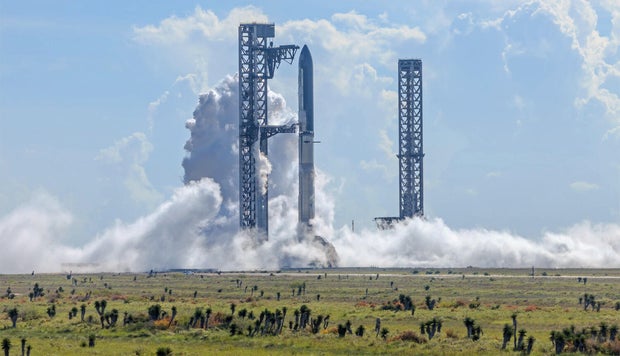
During the most recent previous test flight, three engines suffered problems that prevented a full-duration boost-back burn and only eight of 13 engines fired for the landing burn. The result was a “hard” splashdown. SpaceX implemented multiple upgrades and software changes to ensure a successful return this time around.
The first stage is designed to be captured by giant mechanical arms on its launch gantry, a feat SpaceX has accomplished four times to date. But until upgrades and improvements have been tested, SpaceX has opted to stick with ocean splashdowns. The Starship upper stage also is designed to be captured back at the pad after a trip to space and back, but that milestone has not yet been attempted.
In any case, the Starship upper stage launched Monday was expected to climb into a 180-mile-high orbit with two engine firings. The first, ending a minute after the booster’s splashdown, was intended to put the Starship onto a sub-orbital trajectory similar to past flights that would result in a safe splashdown even if SpaceX lost control of the rocket.
But if its systems are verified to be healthy, a second 11-second Raptor firing will put the ship in a stable orbit. Eight and a half minutes after that, if all goes well, a Pez-like dispenser in the rocket’s nose will begin launching 26 third-generation Starlink internet satellites, each with 10 times the capacity of the previous generation.
After the satellites are deployed, engineers will monitor the Starship and its systems as it cruises around the planet six times, setting up for a de-orbit rocket firing eight hours and 52 minutes after launch.
As with earlier test flights, the Starship will fall back into the discernible atmosphere belly-first, rapidly slowing in a fireball of electrically charged plasma before using its fins and flaps to control its orientation during the descent. Finally, three Raptor’s will re-ignite, the ship will flip up to vertical and settle to a tail first splashdown off the coast of Chile. The planned mission duration: nine hours and 50 minutes.
Future role in Artemis moon program
SpaceX currently has two Super Heavy-Starship pads at its Starbase facility in Texas and three more under construction in Florida, including one at historic pad 39A at the Kennedy Space Center and at the adjacent Cape Canaveral Space Force Station. SpaceX plans its initial launch from Florida late this year or early next.
And multiple pads will be needed.
NASA/SpaceX 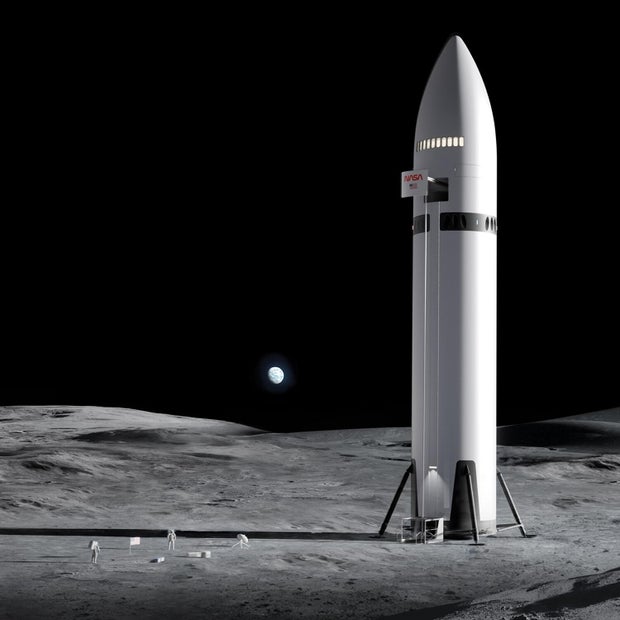
SpaceX is building a variant of the Starship to serve as a lander for Artemis astronauts. For moon missions, the company will need to launch up to 15 or so Super Heavy-Starship tankers to refuel the company’s lunar lander before it can head for the moon to await the arrival of astronauts in a Lockheed Martin-built Orion capsule.
From there, the 165-foot-tall lander will carry two crew members down to the surface, landing vertically near the moon’s south pole. The astronauts then will ride an external elevator down to the surface and back up again when their exploration is complete.
With the first such landing targeted for 2028, SpaceX must ramp up its Super Heavy-Starship test schedule to get the vehicle certified for human spaceflight and to demonstrate the reliability required to safely launch more than a dozen tankers within days of the lander’s launch.
Many observers with past experience at NASA and elsewhere in the aerospace industry doubt SpaceX can deliver a tested “human landing system” Starship variant by 2028. NASA is hedging its bets, funding development of an alternative lander designed by Blue Origin.
During a test flight in low Earth orbit next year — Artemis III — NASA plans to launch four astronauts in an Orion capsule who will attempt to rendezvous and dock with prototype landers launched separately by SpaceX and Blue Origin.