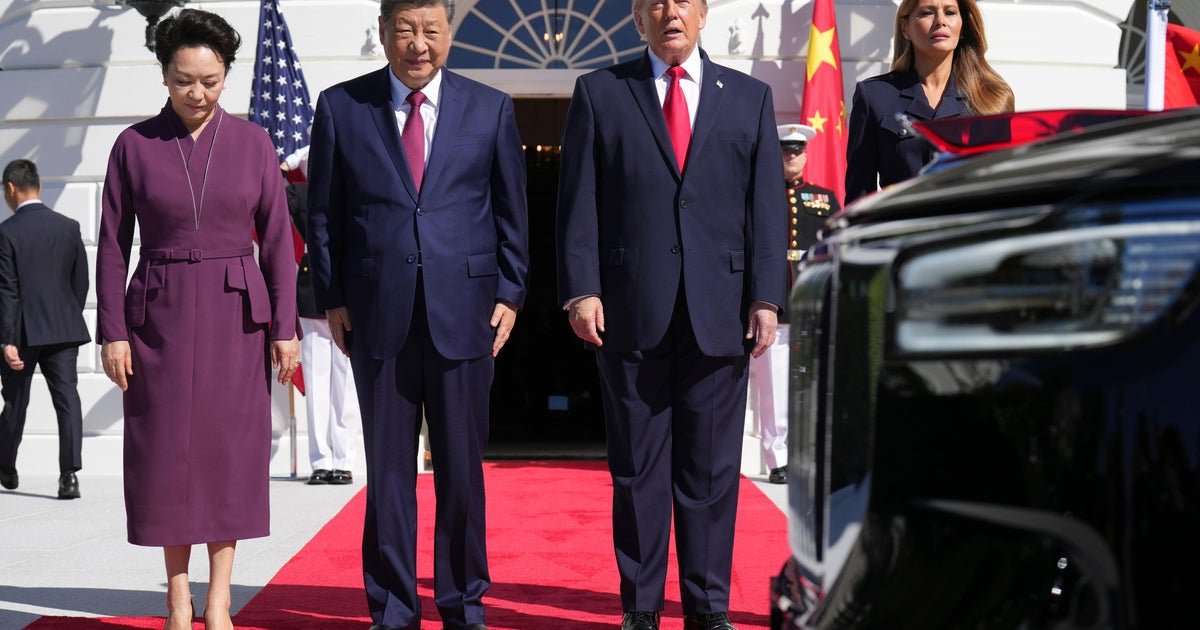
China and the United States agreed to establish a channel for handling AI-related incidents and accelerate work on military crisis communications following a three-day summit between President Xi Jinping and President Trump in Washington, the two governments said Saturday.
They also agreed to continue cooperating through a Board of Trade focused on selected bilateral issues. The White House said the board began operating this week.
The summit produced no major breakthroughs, but analysts said the steps toward greater cooperation were important because they established working groups that could help prevent disputes from escalating.
Xi returned to Beijing on Saturday, according to the state-run Xinhua News Agency. During the visit, Mr. Trump displayed unusual warmth toward Xi, despite having escalated a trade war with China the previous year that had global repercussions.
The two sides agreed to sign a memorandum of understanding on strengthening crisis communications and preventing crises between the two militaries, China’s Foreign Ministry said Saturday in its readout. The one-page statement from the Chinese side was light on details.
Both sides will set up a communication mechanism for artificial intelligence-related incidents, to discuss related risks and benefits, with an AI-specific dialogue scheduled for November.
The White House said the two leaders agreed on using the term “super intelligence” rather than “artificial intelligence” to describe the technology. Mr. Trump has been outspoken about his preference for the alternate term.
“I call it SI because it’s a much better name,” he told reporters Saturday on the White House’s south lawn. “It’s a much more accurate name because when you say the other, it means it’s fake. Artificial means it’s fake, and it’s not fake.”
Mr. Trump also indicated that there would be limits on what the U.S. would share with China and said that Washington would not slow its AI efforts.
The “United States of America is not going to be putting on brakes,” Mr. Trump told reporters outside the White House. “They want to stop our progress because we’re leading China by a lot and we’re going to keep it that way.”
He added: “I would rather not integrate because we’re leading by a lot. When you’re leading, you don’t open it up to each other. We’re leading by at least a year, maybe a year and a half. Some people say two years. I’m not looking to open it up.”
The statement from China said both sides will continue to work together on the pledge to reduce reciprocal tariffs on roughly $30 billion worth of goods. During the summit, the two leaders agreed to extend a trade truce by two months. The White House statement said China agreed to import at least 10 million metric tons of coal from the U.S. in 2027 and 2028.
Most of the reduction in tariffs is aimed at non-sensitive goods, such as agricultural products or holiday decorations.
The two countries also established the Board of Investment to “discuss potential investment opportunities and investment-related impediments and to provide a structured channel for the two sides to address commercially meaningful investment-related issues,” the White House said.
The statement from the White House also said the two sides continued to work on American concerns about rare earths supply, “with the goal of ensuring shipment levels return to appropriate levels.” China put export controls on rare earths last year in response to the U.S. tariffs, cutting the supply sent to the U.S. and other countries.
Both sides agreed to meet at the Asia-Pacific Economic Cooperation summit in Shenzhen, China, in November, and then later at the G20 at the Trump National Doral Miami golf club in Florida.
Both governments said Iran should honor its stated commitment not to develop nuclear weapons. They also said no country should charge tolls on international waterways, an apparent reference to the Strait of Hormuz, where traffic has fallen significantly since the U.S. war with Iran began.
The U.S. statement welcomed China’s decision to impose export controls on two additional precursor chemicals used to produce fentanyl. Both sides also noted recent arrests in fentanyl-related cases.
Although the summit did not resolve the countries’ fundamental differences, analysts said the incremental progress was noteworthy.
“Personal diplomacy between the two leaders is important, but the emphasis on working-level engagement, military-to-military dialogue and crisis-management mechanisms suggests an effort to make that stability more durable and institutionalized,” said Wang Zichen, deputy secretary-general of the Beijing-based Center for China and Globalization.