Thursday and Friday festivities: Military bands, F-22 flyovers, state dinner
President Trump and first lady Melania Trump have planned an elaborate arrival ceremony at the White House for their Chinese counterpart, marking Xi’s first visit in over a decade.
The ceremony will begin on the South Lawn shortly after 10 a.m. ET on Thursday, and will involve a flag display, an Armed Forces Full Honor Cordon and the United States Army Herald Trumpets, according to the White House.
The ceremony will then move inside the White House, where a Marine band will play the countries’ national anthems and Mr. Trump and Xi will give remarks and exchange gifts. A military review is expected in the Rose Garden. The ceremony concludes with a military flyover involving a B-2 Spirit and four F-22 Raptors.
Starting at 11:30 a.m., Mr. Trump and Xi will hold bilateral meetings in the Oval Office.
Melania Trump has planned a visit to the Smithsonian National Museum of Asian Art with Xi’s wife, Peng Liyuan, while their husbands participate in meetings.
On Thursday night, the Chinese leader and his wife will return to the White House for a state dinner in the East Room. They will be greeted by Mr. Trump and the first lady at 6:45 p.m., and the two world leaders will deliver remarks in the East Room just over an hour later.
The Trumps will also host Xi and Peng on Friday morning for tea in the Red Room before they visit the National Archives and fly back to China.
Several tech executives will attend state dinner
Nvidia CEO Jensen Huang and Qualcomm CEO Cristiano Amon will both attend the White House state dinner, according to sources familiar with their plans. OpenAI’s Chris Lehane confirmed to CBS News that Sam Altman will be attending as well.
Additionally, JPMorgan’s Jamie Dimon will attend the dinner, according to a person familiar with his schedule.
Trump rolled out red carpet for Xi’s arrival
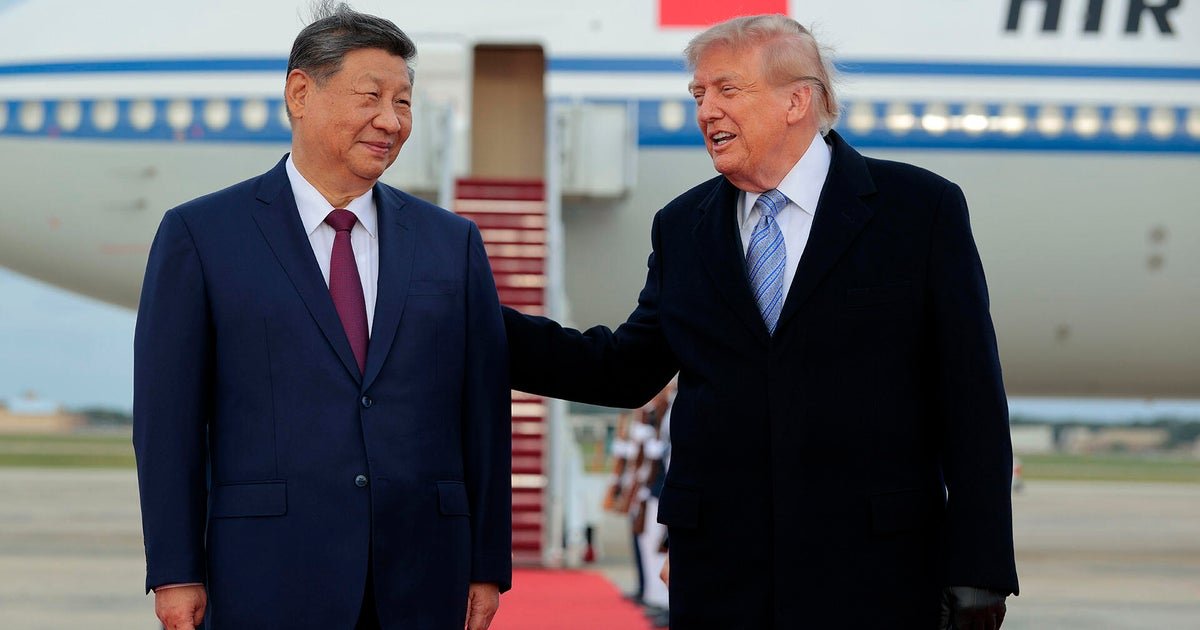
Xi landed at Joint Base Andrews in Maryland before 6 p.m. Wednesday, with his Air China jet rolling past six F-16s and six F-22s that were lined up on the tarmac.
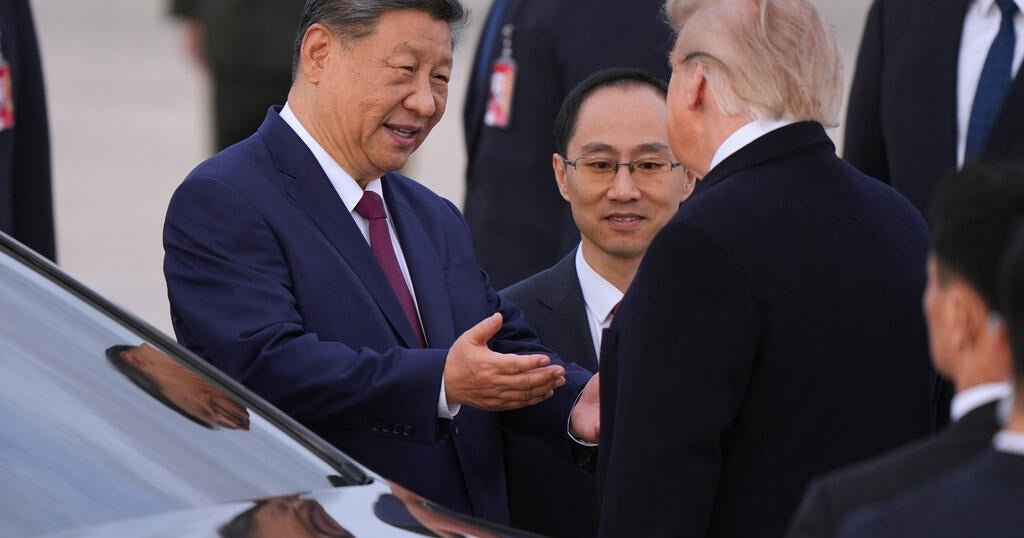
Before Xi and his wife, Peng Liyuan, exited the plane, Mr. Trump and first lady Melania Trump arrived in the presidential car, known as The Beast, and walked down the red carpet to the stairs descending the plane.
A U.S. Air Force band played as Xi and his wife walked down the steps to the awaiting Trumps.
The arrival ceremony — which included a flyover with two B-1 bombers, a 21-gun salute and the Star-Spangled Banner — was quick, and Mr. Trump and the first lady departed about 10 minutes later.
What Trump and Xi may discuss on tariffs and trade
One day before Thursday’s state visit, top U.S. and Chinese economic officials agreed to extend their truce on tariffs for two months, Treasury Secretary Scott Bessent told Fox News.
That deal — struck last fall in Busan, South Korea — was initially set to expire Nov. 10. It lowered tariffs levied by both countries, paused restrictions on Chinese exports of rare earth minerals and said China would continue to buy large quantities of U.S. soybeans, a pledge China has failed to keep.
The truce allowed the two countries to climb down from a tit-for-tat trade war that sent U.S. and Chinese tariffs to more than 100% at one point in spring 2025. Bessent told Fox News it was extended until January to “give us more time to see what we can do on the economic front.”
Bessent, who met with Chinese Vice Premier He Lifeng over the weekend and on Wednesday, said this week the Chinese have proposed a “bigger deal” on trade between the U.S. and China, beyond the trade truce brokered in Busan in October.
“We’re open to the idea of just continuing the Busan arrangement, or examining the bigger deal,” Bessent told reporters Wednesday. “We’re fine with both, and we’re going to do what’s best for the American people.”
On Fox News Monday, U.S. Trade Representative Jamieson Greer said there will be an announcement establishing a U.S.-China “Board of Trade,” which will determine a “relatively small subset of goods” that the two countries agree they should protect from trade disputes. That may include things like low-tech consumer goods and some agricultural products, Greer said. The idea of such a board was discussed when Mr. Trump and Xi met in May.
Trump and Xi may talk artificial intelligence
Artificial intelligence is on the Trump-Xi agenda, a White House official told reporters on a call Friday on the condition of anonymity, although the person didn’t elaborate.
Amid growing public pressure for the U.S. government to implement more safeguards around advanced AI, Bessent shared over the weekend that the U.S. has proposed a new “notification system” with China to alert AI incidents that affect national security.
Mr. Trump’s stance on that idea is unclear. His most-voiced concern about AI is the need for the U.S. to beat China, and he has spoken out against reining in the speed of AI research.
Trade restrictions also block China from buying certain advanced computer chips that power AI models, though Mr. Trump has allowed Nvidia to sell some of its chips to “approved customers.”
Will Trump talk about Iran?
Last week, Mr. Trump dismissed a report from The Wall Street Journal that Chinese entities provided Iran with satellite imagery of a base used by the U.S. military before an Iranian strike killed three U.S. soldiers and wounded four others in Jordan.
Instead, Mr. Trump offered a nod of appreciation for Xi.
“I think he’s behaved reasonably well, and we behave reasonably well,” Mr. Trump said of Xi regarding Iran.
China’s trade relationship with Russia is also drawing scrutiny amid the Russian invasion of Ukraine. Last week, Mr. Trump signed a bipartisan bill that calls for hefty tariffs on the largest importers of Russian oil — a list that China tops.
Taiwan is a key issue for Xi
Beijing is looking to reclaim Taiwan and wants the U.S. to stay out of the way, says James Lewis, a distinguished fellow with the Tech Policy Program at the Center for European Policy Analysis. The U.S. has a multibillion-dollar deal to sell arms to Taiwan, and “the Chinese hate that,” Lewis said.
When Mr. Trump visited Beijing in May, Chinese state media reported that Xi warned Mr. Trump of potential “clashes and even conflicts” if the Taiwan issue isn’t “handled properly.” Xi has said China’s “reunification” with Taiwan is “unstoppable,” and the Trump administration has given little indication it wants to intervene, despite decades of U.S. support for Taiwan’s autonomy.
“Xi has very definite goals with Taiwan and hopefully Trump won’t misspeak and make any kind of concessions,” Lewis said.
Taiwan is far and away the world’s largest producer of semiconductor chips, one of the many issues at play should Beijing move to take control of the island of more than 23 million people.
The U.S. has a longstanding policy of refusing to state whether or not it would intervene militarily if China attacks Taiwan, a practice known as “strategic ambiguity.”
China experts say not to expect many big policy moves
China experts say to not expect many tangible policy outcomes from the Trump-Xi meeting. Lewis said there “isn’t much of a formal agenda” for the two leaders.
“I’m not anticipating very much — I don’t think anyone is,” Lewis said. “Because this is largely for show. And it’s largely a discussion between two very cautious and two very suspicious leaders.”
“I don’t think there’s too much hope for policy achievements,” said Jake Werner, director of the East Asia Program at the Quincy Institute for Responsible Statecraft.
“Probably more than anything, Trump loves a show,” Werner added. “And then I think … he has a desire to make sure that China doesn’t use the power that it demonstrated that it has last year when it cut the U.S. off of rare-earth elements, and American factories started shutting down.”